Silvia Perossio Esteves
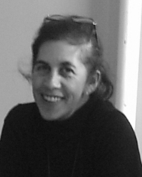
Silvia Perossio Esteves was born in Montevideo on January 10, 1961. Their ancestors were from Ronco Scrivia, Francesco Perosio and Luigia Bondanza (See The Perossio Artola).
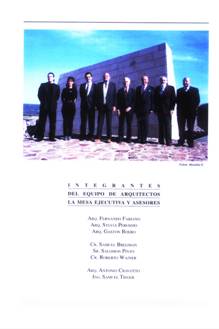
She graduated in 1989 from the Faculty of Architecture of the University of the Oriental Republic of Uruguay, with the title of Architect. In 1999 she completed a Master's degree in Intelligent Buildings and Bioclimatic Architecture at the Universidad Politécnica de Madrid – Escuela Técnica Superior de Arquitectura de Madrid. She has worked as Associate Professor G. 3 of the Faculty of Architecture in the Workshops of Sommer, Sprechman, Otero and Perdomo. She is the author of various published articles, among which "The sense of looking" in collaboration with Architect Gastón Boero stands out. She obtained the Prize of the Competition of the Memorial to the Holocaust of the Jewish People, associated with Arq. G. Boero and F. Fabiano.
Several works and won competitions of architecture, the most renowned:
"In Memory to the Holocaust of the Jewish Town"
First Prize in National Competition of 1994 in Uruguay
Declared National Historical Monument
Selected in the Biennial World cup of Architecture 1995 representing Uruguay
Exposed in the Biennial of Chile
Selected among the best Latin American works, for the Fundación Mies van der Rohe - 1998
Exposed in the The Museum of Modern Art de Nueva York.
Rambla of Montevideo, Uruguay.
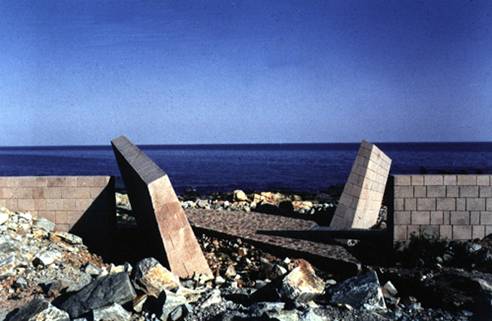
This work is not a work that belongs to the Jewish community.
It is a national Uruguayan work. It was conceived from a political point of view by the authorities of the time and carried out with popular effort. The Jewish community collaborated as did other communities, and in general all the population supported the construction of this Memorial.
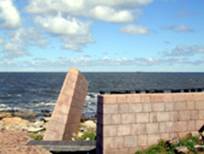
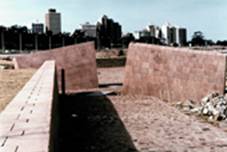
The Memorial is located on the Rambla Wilson of Montevideo facing the golf course. Seen from the promenade it appears as an oblong line of stone. It consists of a wall of 10 meters in length, parallel to the river Rio de La Plata. In its development it has diverse characterizations. The Wall symbolizes the Jewish People and the Break of the wall symbolizes the Holocaust. Despite this break, the wall maintains its integrity and is directed toward hope. From the coast the Memorial has another power. It is accessed from the western end along the Path of descent that leads to the break.
The structure of the construction of granite stones similar to "ashlars" generates a visual association as if it were the Wailing Wall and the Southern Promenade, integrating at the same time the biblical culture and the national one. The break of the wall and of the adjacent pavements generates a situation of insecurity. There two large Stones of bewilderment are separated, inclined toward the sea, that impede a clear view of the future. There is a before and an after that are traversed through the Bridges of doubt which connect the break with the Valley of Meditation. It is a place for intimacy, in which the wall acquires its maximum expression in dimensions.
It is an urban space of great force, isolated from the promenade, expanded toward the natural coastal landscape. The pavement is irregular, of texture and color similar to the stones of the site. After the square, the exit is produced by a wide staircase and an ascending ramp that rises, ultimately, toward the Road of Hope. Its location at the edge of the river suggests the opening of the waters so that the people may pass to liberty, as if it were at the same time the place through which the immigrants who found shelter in Uruguay entered.